ILLUSTRATED BIOGRAPHY · KUNSTDORF VERLAG
Franz Marc
Religion, Art and Modern Europe
How does artistic freedom become possible, and what does it ask of other people?
English and German editions in preparation
ART, AFFECTION AND DISAGREEMENT
A shared life.
Separate purposes.
In March 1915, Franz and Maria Marc were separated by war and arguing about art. She had helped prepare his writing for publication. Now she questioned its purposes. He welcomed her criticism, defended himself, and reconsidered.
This biography follows the religious convictions, household labor, collectors’ advances, friendships, and institutions that sustained Marc’s work. Maria’s own painting, judgment, and later preservation of his legacy remain central to the account.
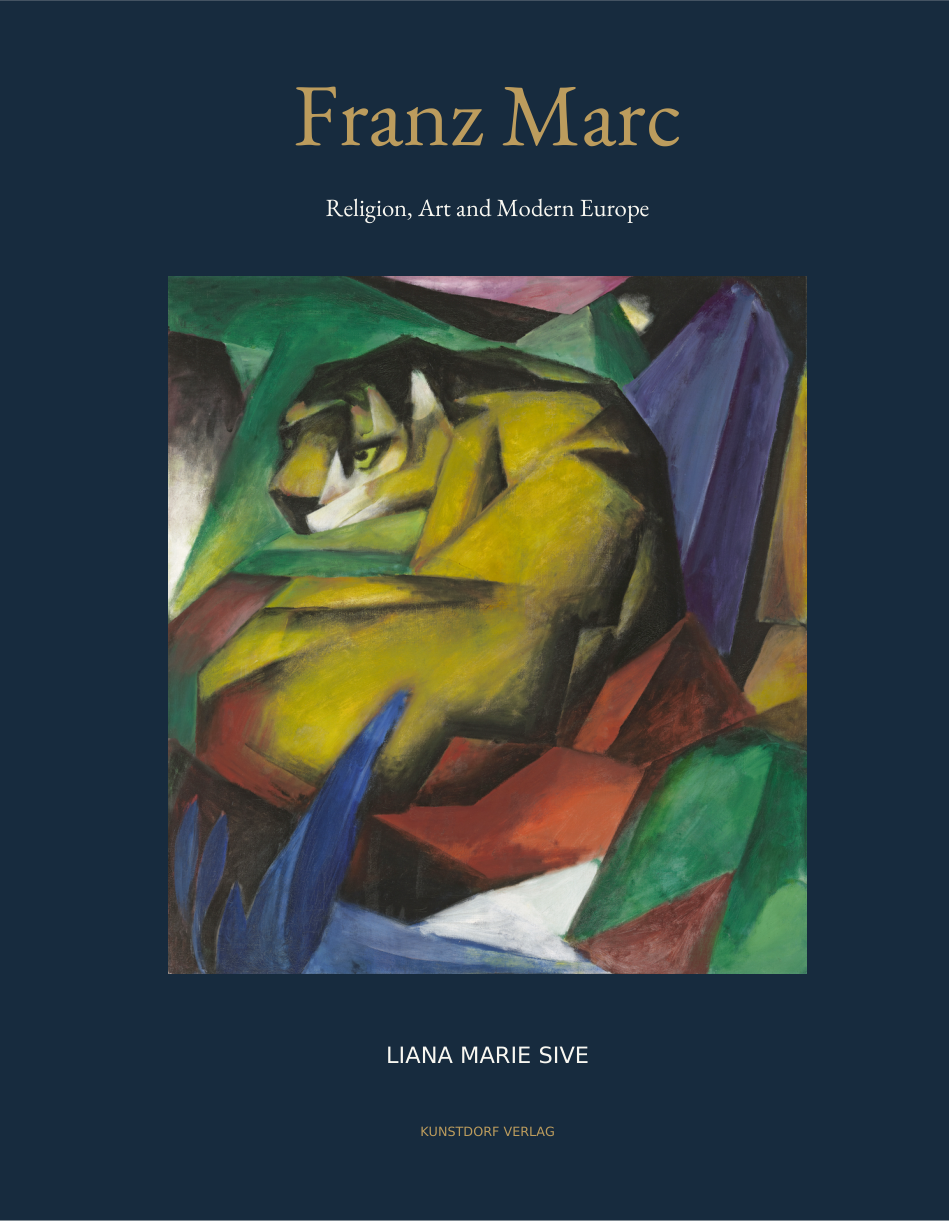
Close readings of Tiger, Yellow Cow, and other paintings bring the argument back to decisions made on canvas. The same work can return as an artistic experiment, a proposed sale, and a document altered by its later transmission.
FROM THE PREFACE
The freedom to work
Maria was an artist whose purposes sometimes converged with Franz’s and sometimes required room of their own. Their relationship gives this book its central question: how did artistic freedom become possible, and what did its exercise require of other people? A collector’s advance could protect the painter’s choice of pictures. A collaborator could prepare a text for print and then oppose its publication. Each freedom involved people whose agreement could not be assumed. Across these relationships, the biography follows the passage from a conviction to the work, resources, and recognition needed to act upon it. Religious belief, economic arrangements, political institutions, and the making of pictures enter the same history. Its subject is the freedom people could secure, contest, and use, together with the consequences for those whose own purposes that freedom affected.
The composition resembles a kaleidoscope: familiar elements form different patterns as the angle of attention changes. Yellow Cow, painted in 1911, returns under three questions. Chapter 8 follows the terms of its sale in 1915; Chapter 12 returns to its color and preparatory studies; Chapter 24 follows the sale into a later edition of the letters. These are different moments in the life of one painting. The correspondence of 1915 illuminates its later history without supplying motives for every earlier decision.
From Franz Marc: Religion, Art and Modern Europe · © 2026 Liana Marie Sive
INSIDE THE BOOK
A life viewed from several angles.
The opening chapters, “Three letters” and “Tiger,” lead into six parts.
Part I Inherited worlds
- The household as a place of production
- Belief and the authority to choose
- The country within the city
- Becoming entitled to work
Part II The conditions of artistic freedom
- Other people’s lives
- The price of time
- Making an audience
- The house at Ried
Part III The construction of another nature
- Watching animals
- The work of color
- Images of belief
- Breaking the contour
Part IV The search for order
- Books in use
- Hearing another art
- Making the Blue Rider
- Another person’s judgment
Part V War within the life
- Bavarian, European, soldier
- Penzberg
- Work still to be done
- March 4, and afterward
Part VI The possession of Marc
- Maria after Franz
- When letters become a book
- The second purchase
- The received Marc
A coda and methodological essay are followed by the Lebenslauf, people and relationships, principal works, illustration register, bibliography, acknowledgments, author biography, index, and notes.
THE AUTHOR AND THE SUBJECT
An encounter that lasted.
Sive first encountered Marc in an art-history survey at Santa Ana College while still in high school. In 1981, after studying German from fourth through twelfth grade, she spent three months in Munich and saw his paintings in person.
Marc later appeared as an imagined figure in The Schattendorf Echoes. The biography returns to the historical person through paintings, correspondence, published editions, and the records of his work’s preservation.
Jacket painting: Franz Marc, Tiger, 1912. Städtische Galerie im Lenbachhaus und Kunstbau München, Bernhard und Elly Koehler Stiftung 1965. Image: Lenbachhaus, CC0.