ILLUSTRATED BIOGRAPHY · KUNSTDORF VERLAG
Franz Marc
Religion, Art, and Modern Europe
Where Maria Franck-Marc’s objections have been judged inadequate to Franz’s philosophy, this biography asks whether his philosophy can withstand her objections. It follows what his concessions changed, whose work and money sustained his artistic freedom, and how the editing of his letters shaped his legacy.
Completed English and German manuscripts available for private professional review
ART, AFFECTION, AND DISAGREEMENT
A whole life.
Four claims that change its reading.
Maria’s objection tests Franz’s philosophy. Her refusal of purification through evil exposes, in Sive’s reading, a gap in his justification of war. Katja Förster had already distinguished his artistic concessions from his continuing defense of war; Sive’s disagreement concerns the force she assigns Maria’s criticism.
His concessions had limits. On April 7, 1915, explicitly answering Maria’s March 29 letter, Franz declared that he would withdraw “II.” The biography distinguishes a promise from evidence that publication changed. His freedom rested on unequal conditions. Koehler’s advances, Maria’s manuscript work, and delayed payments for Yellow Cow show whose time and resources sustained it.
Editions helped construct his legacy. The 1920 letters omitted a proposed sale price and his monthly pay while retaining a contemplated gift of 100 marks. The biography establishes the textual effects while keeping editorial responsibility and motive open where they remain unproved. Read the claims and worked source comparisons ↗
The full life runs from religious formation through animal studies, color, the Blue Rider, friendships, war, and death to Maria’s weaving and the later making of Marc’s reputation. Close readings of paintings remain central. Completed manuscripts are available for review; further source collation, scholarly review, and catalogue integration continue toward publication.
FROM THE PREFACE
The freedom to work
Maria was an artist whose purposes sometimes converged with Franz’s and sometimes required room of their own. Their relationship gives this book its central question: how did artistic freedom become possible, and what did its exercise require of other people? A collector’s advance could protect the painter’s choice of pictures. A collaborator could prepare a text for print and then oppose its publication. Each freedom involved people whose agreement could not be assumed. Across these relationships, the biography follows the passage from a conviction to the work, resources, and recognition needed to act upon it. Religious belief, economic arrangements, political institutions, and the making of pictures enter the same history. Its subject is the freedom people could secure, contest, and use, together with the consequences for those whose own purposes that freedom affected.
The composition resembles a kaleidoscope: familiar elements form different patterns as the angle of attention changes. Yellow Cow, painted in 1911, returns under three questions. Chapter 8 follows the terms of its sale in 1915; Chapter 12 returns to its color and preparatory studies; Chapter 24 follows the sale into a later edition of the letters. These are different moments in the life of one painting. The correspondence of 1915 illuminates its later history without supplying motives for every earlier decision.
From Franz Marc: Religion, Art, and Modern Europe · © 2026 Liana Marie Sive
INSIDE THE BOOK
A life viewed from several angles.
The opening chapters, “Three letters” and “Tiger,” lead into six parts.
Part I Inherited worlds
- The household as a place of production
- Belief and the authority to choose
- The country within the city
- Becoming entitled to work
Part II The conditions of artistic freedom
- Other people’s lives
- The price of time
- Making an audience
- The house at Ried
Part III The construction of another nature
- Watching animals
- The work of color
- Images of belief
- Breaking the contour
Part IV The search for order
- Books in use
- Hearing another art
- Making the Blue Rider
- Another person’s judgment
Part V War within the life
- Bavarian, European, soldier
- Penzberg
- Work still to be done
- March 4, and afterward
Part VI The possession of Marc
- Maria after Franz
- When letters become a book
- The second purchase
- The received Marc
A coda and methodological essay are followed by the Lebenslauf, people and relationships, principal works, illustration register, bibliography, acknowledgments, author biography, index, and notes.
THE AUTHOR AND THE SUBJECT
An encounter that lasted.
Sive first encountered Marc in an art-history survey at Santa Ana College while still in high school. In 1981, after studying German from fourth through twelfth grade, she spent three months in Munich and saw his paintings in person.
Marc later appeared as an imagined figure in the two Schattendorf cycles. The biography returns to the historical person through paintings, correspondence, published editions, and the records of his work’s preservation.
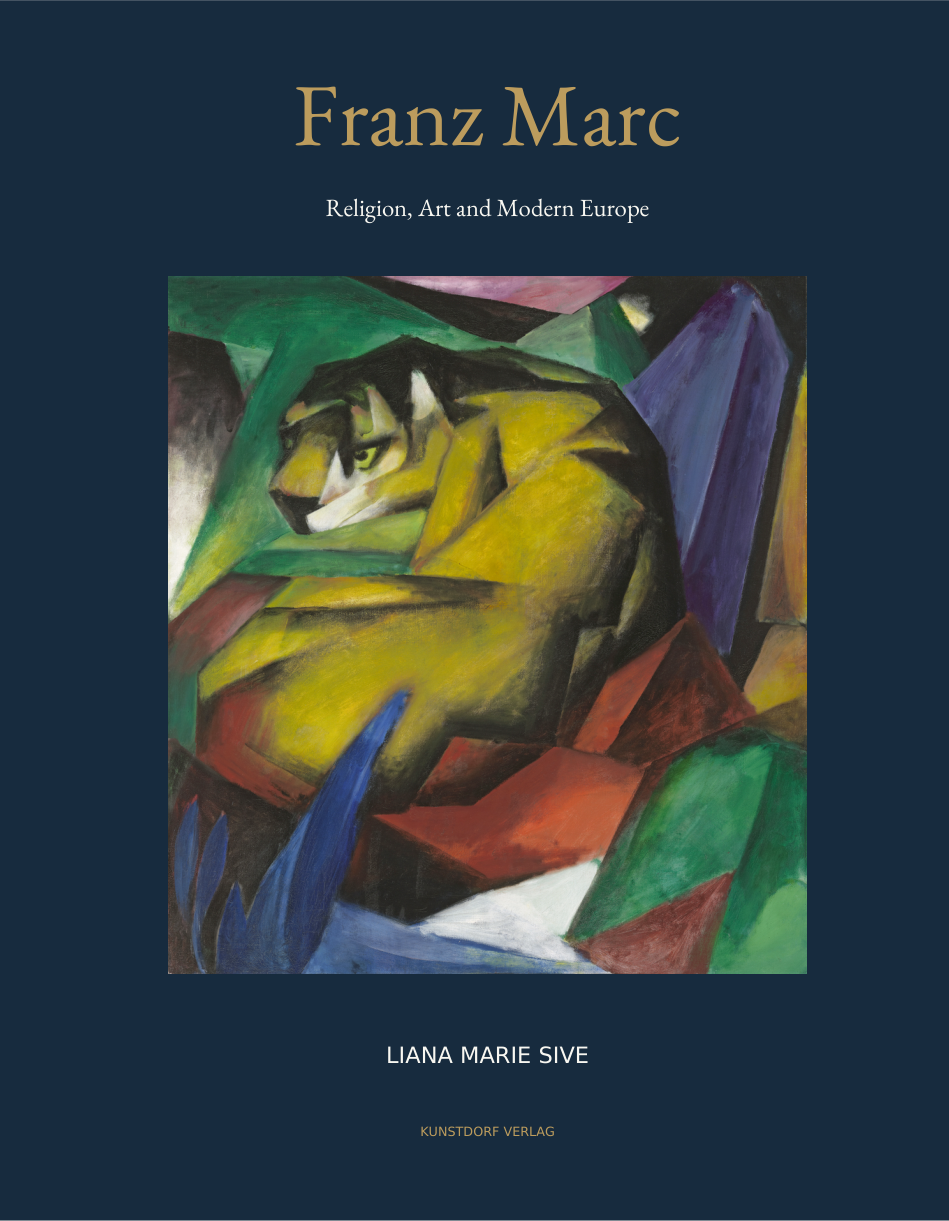
Jacket painting: Franz Marc, Tiger, 1912. Städtische Galerie im Lenbachhaus und Kunstbau München, Bernhard und Elly Koehler Stiftung 1965. Image: Lenbachhaus, CC0.